The easy methods are quite straightforward: you follow the steps, and if applicable, the solution becomes immediately clear in the corresponding cell. With more advanced techniques, particularly in simpler cases, this direct approach may also work. However, in most cases, it's typical to record several potential solutions in a cell using small numbers, and then systematically eliminate incorrect options. Once narrowed down to one candidate, you've identified the solution for the cell. At that stage, you erase the multiple numbers, leaving only the final solution in the cell.
Here's the process: When you reach a point where the easy methods don't reveal the next solution step, you systematically examine each cell. Using a pencil, you mark down small numbers to signify the potential candidates for a particular cell. This results in each unsolved cell containing more than one number.
In some cases, it's sufficient to apply this process within specific boxes or regions. However, as the puzzle increases in complexity, you may need to utilize this method across the entire puzzle.
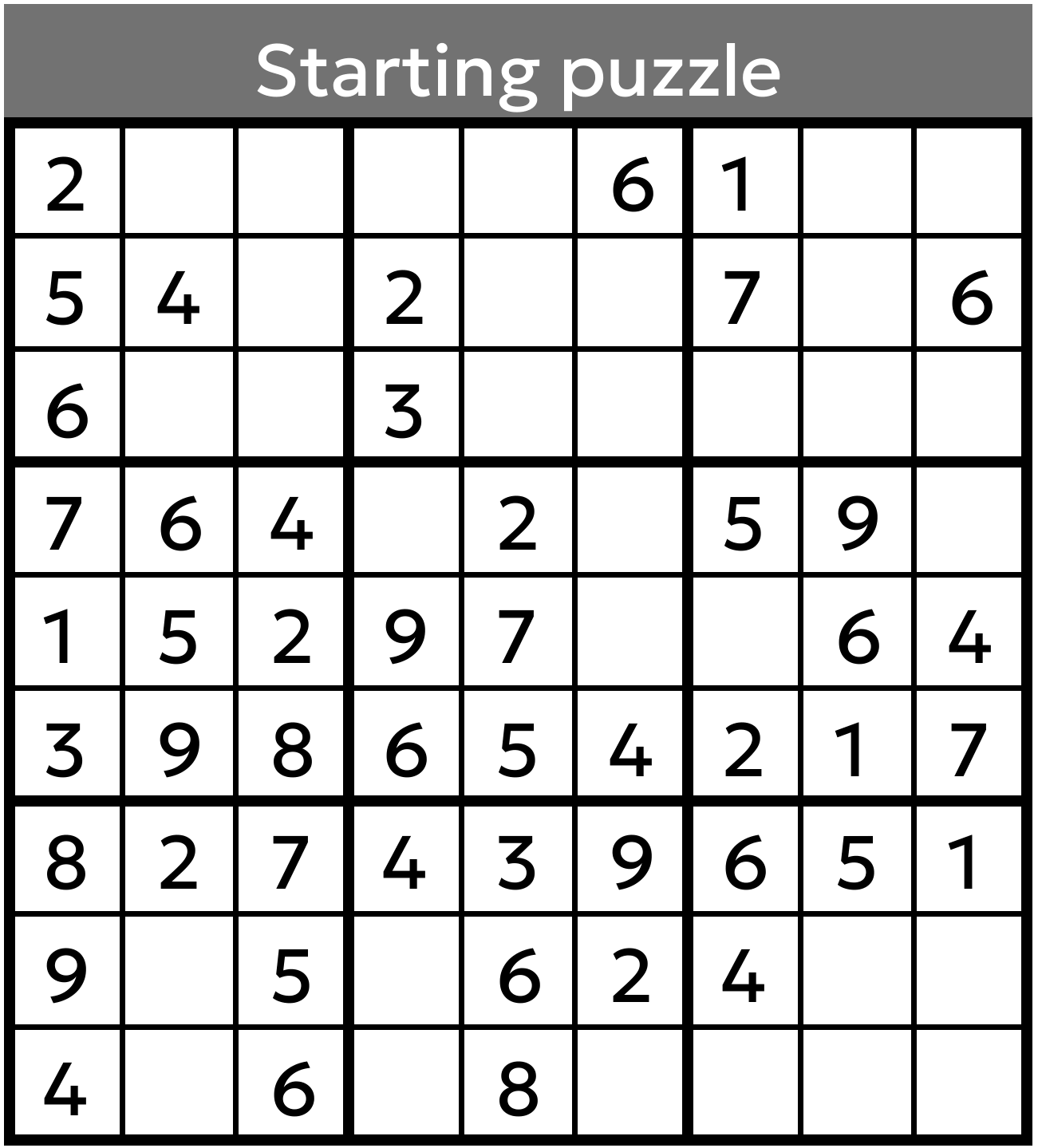
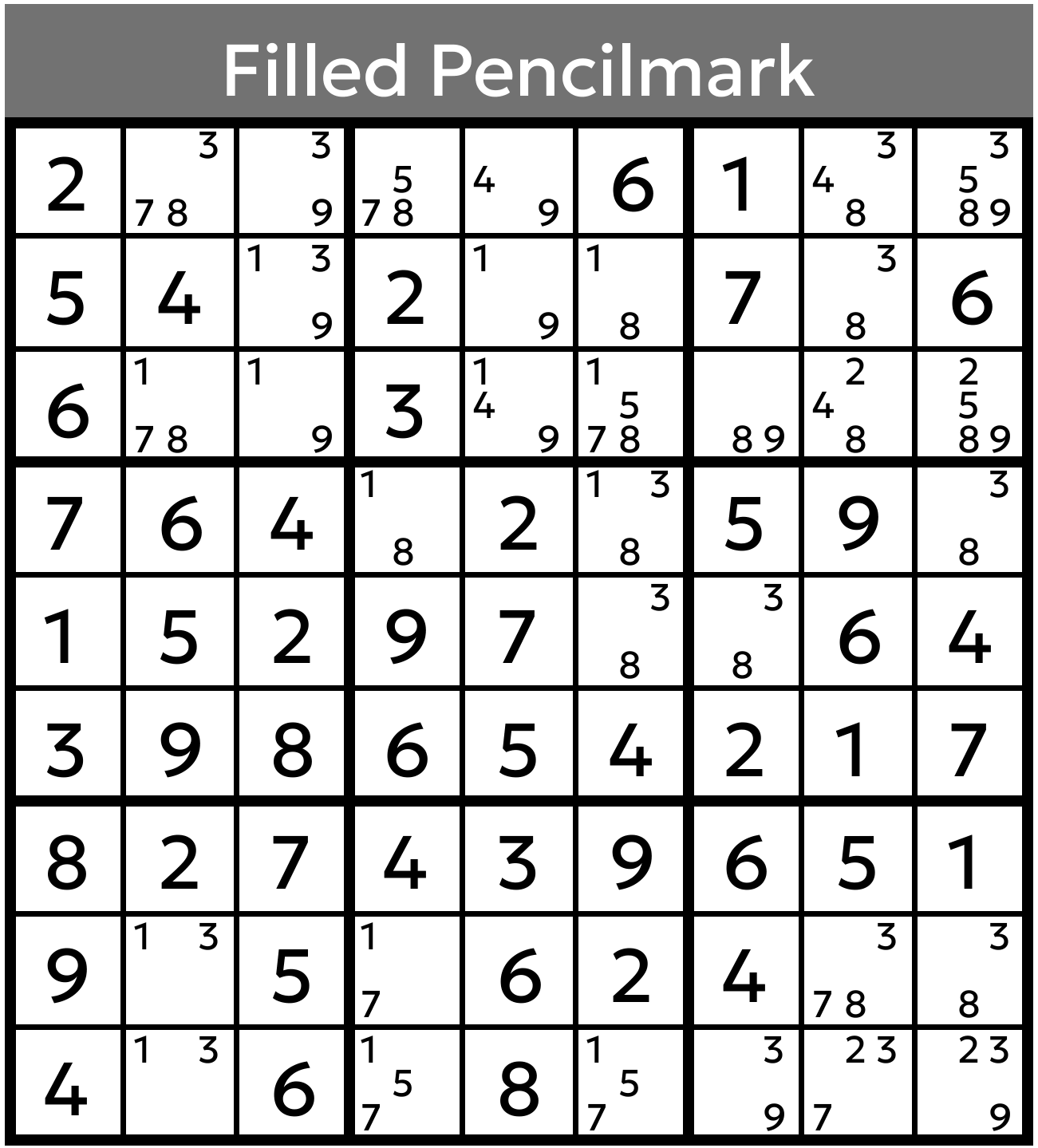
Take a look at the example above! Notice that in the illustration, the small numbers are organized in a 3x3 sub-grid within the cell, with each number positioned accordingly. Typically, this layout makes it easier to identify certain solution patterns. However, feel free to use other alternatives if you find them more convenient.
Once you've completed adding these small numbers, you proceed to apply the patterns that will be detailed on the individual method pages. While these methods may not offer an immediate solution for a particular cell, they will indicate which numbers you can eliminate from the candidate list.
Look at the example below:
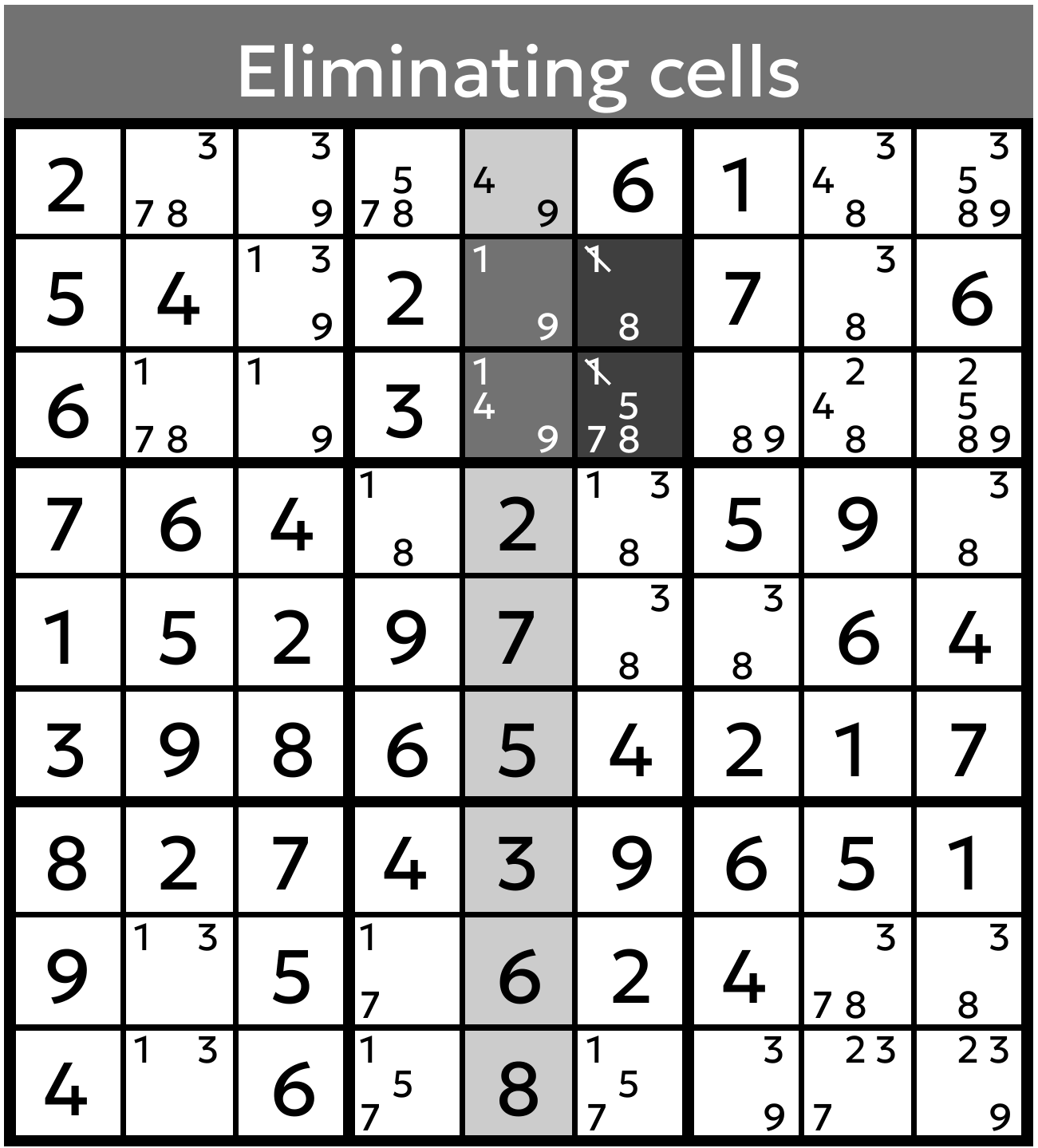
Later on, you'll observe that the pointing pair method will reveal that 1 cannot be the solution in the dark highlighted cells in column 6, rows 2 and 3. In the cell at row 2, column 6 there were initially two candidates: 1 and 8. Eliminating 1 as a possible solution leaves 8 as the sole final solution. You can then erase the pencil marks in the cell and proceed with solving the puzzle.
In most instances, you can proceed further with the easy methods. In the example provided above, once it becomes evident that the solution in the dark shaded cell in row 2 is 8, you can promptly remove 8 from other cells in the same row, column, and box. This immediately leads to further findings, such as identifying 3 in the same row and column 8, as well as determining 3 in the same column and row 5.
Simple next step
In the previous example, a result was promptly identified after the elimination process. However, it's not always the case; often, immediate results may not follow. Nevertheless, in many instances, you do encounter a simple next step in the solving process.
Take a look at the example below.
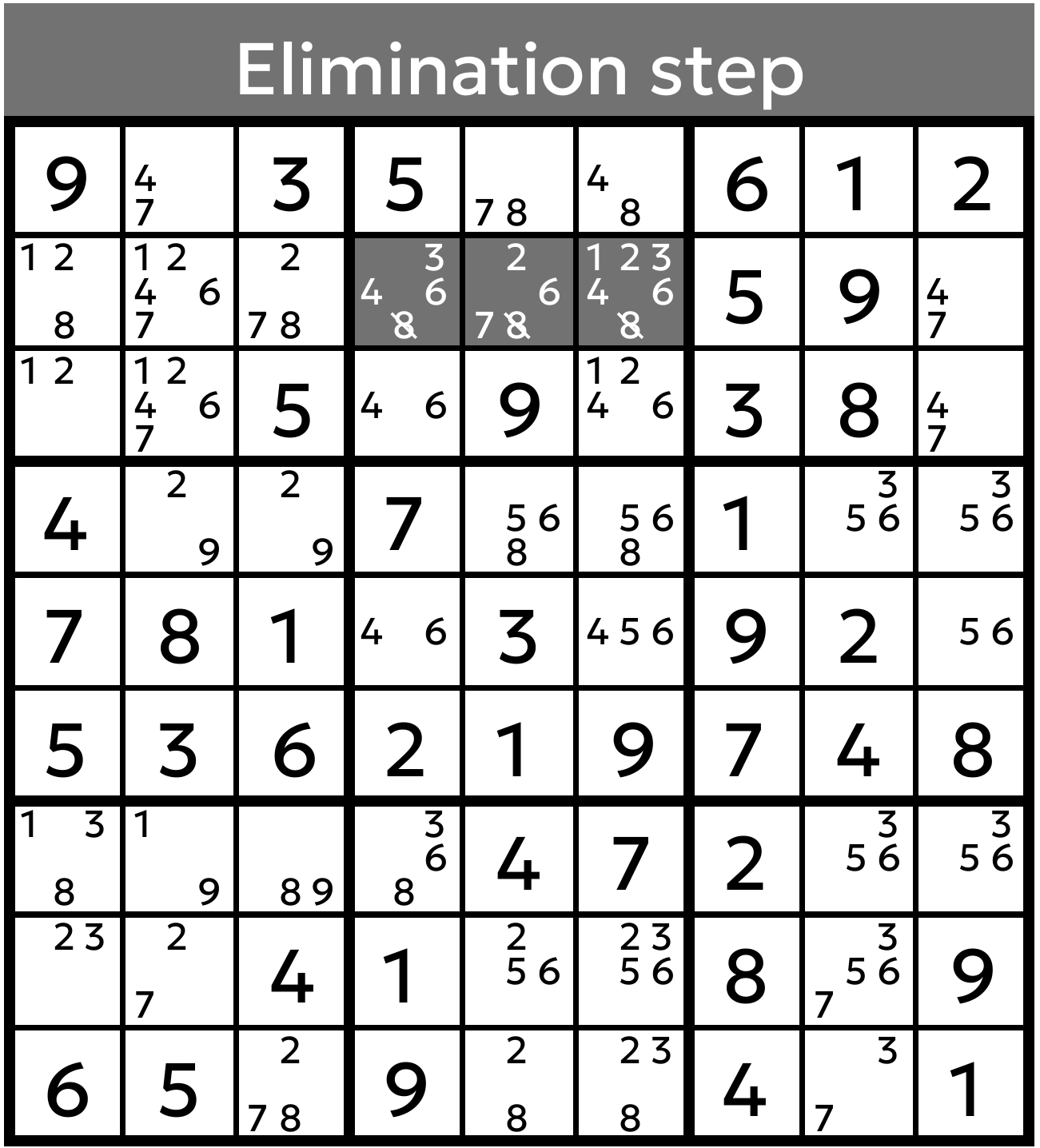
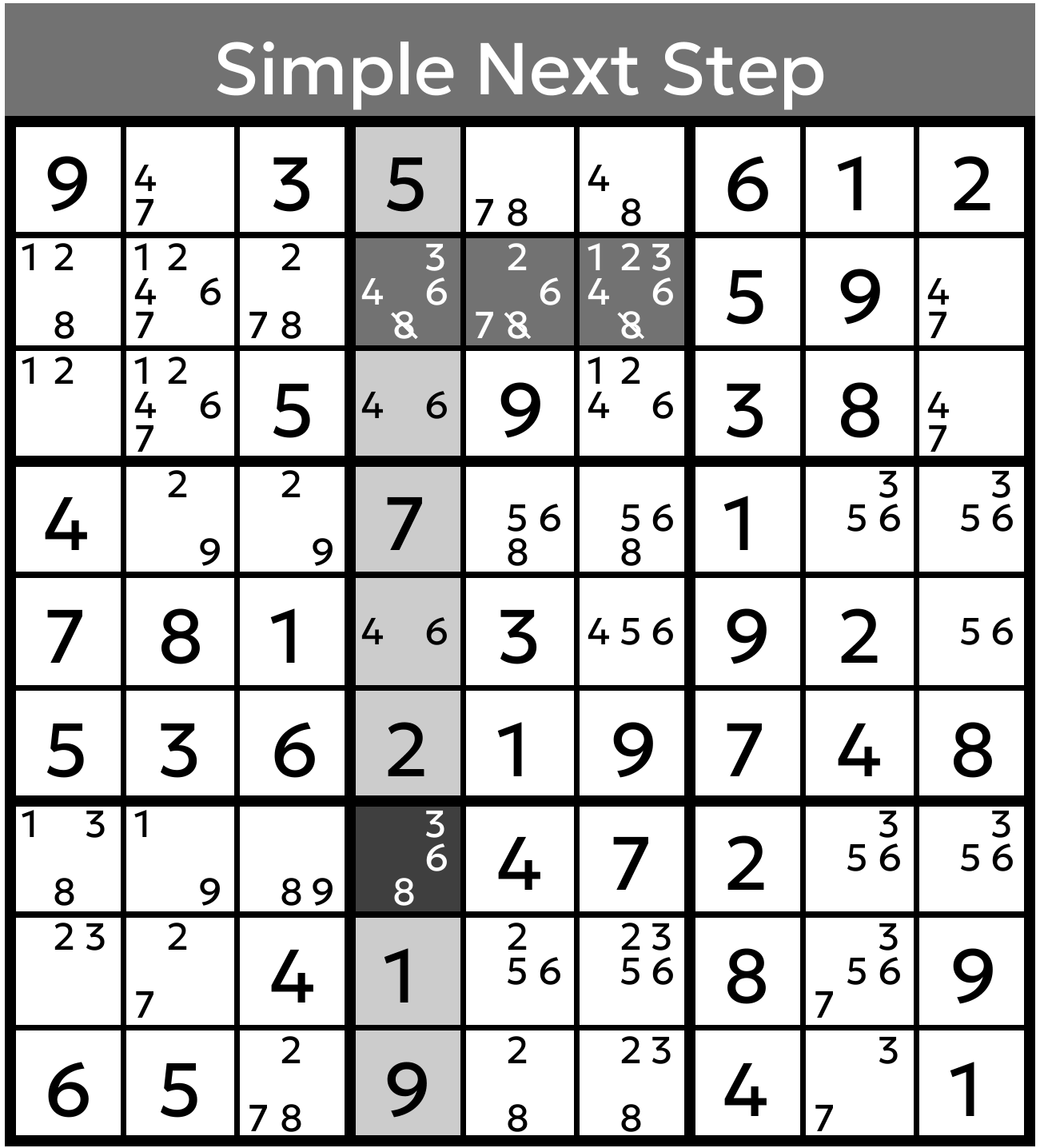
This example illustrates that by applying a specific method, you successfully removed the value 8 from three cells in the second row. In this specific case, despite the eliminations, more than one candidate remains in these cells. However, don’t give up!
As a next step, examine whether these eliminations lead to further possibilities.
Take note of the situation in column 4 regarding the value 8! Since 8 was eliminated from the second row, the only remaining possibility in this column for number 8 is now row 7. This means you've identified a single solution for the cell in row 7, column 4! You can now proceed with the easier methods. In this example, after setting 8 as a solution for the cell in row 7, column 4, the value 9 becomes a single candidate in row 7, column 3, and so on.
Eliminate further
Sometimes, the elimination process may not yield an immediate or straightforward solution. Don't worry! Simply continue applying the elimination methods further.
6/page · Moderate #1 in the free sample, move 7. Open the app at this move and step through it.