This method group has multiple variants and goes by different names, such as pointing or claiming pairs & triples, box-line reduction, candidate lines, multiple lines, and more. In numerous instances, you can identify this pattern visually, even without relying on pencil marks.
A variant
You aim to identify a value for which all possible positions within a line (either a row or column) lie within the same box. When such a situation arises, you can eliminate that value from the other similar lines (rows or columns) of the same box. Take a look at the example below:
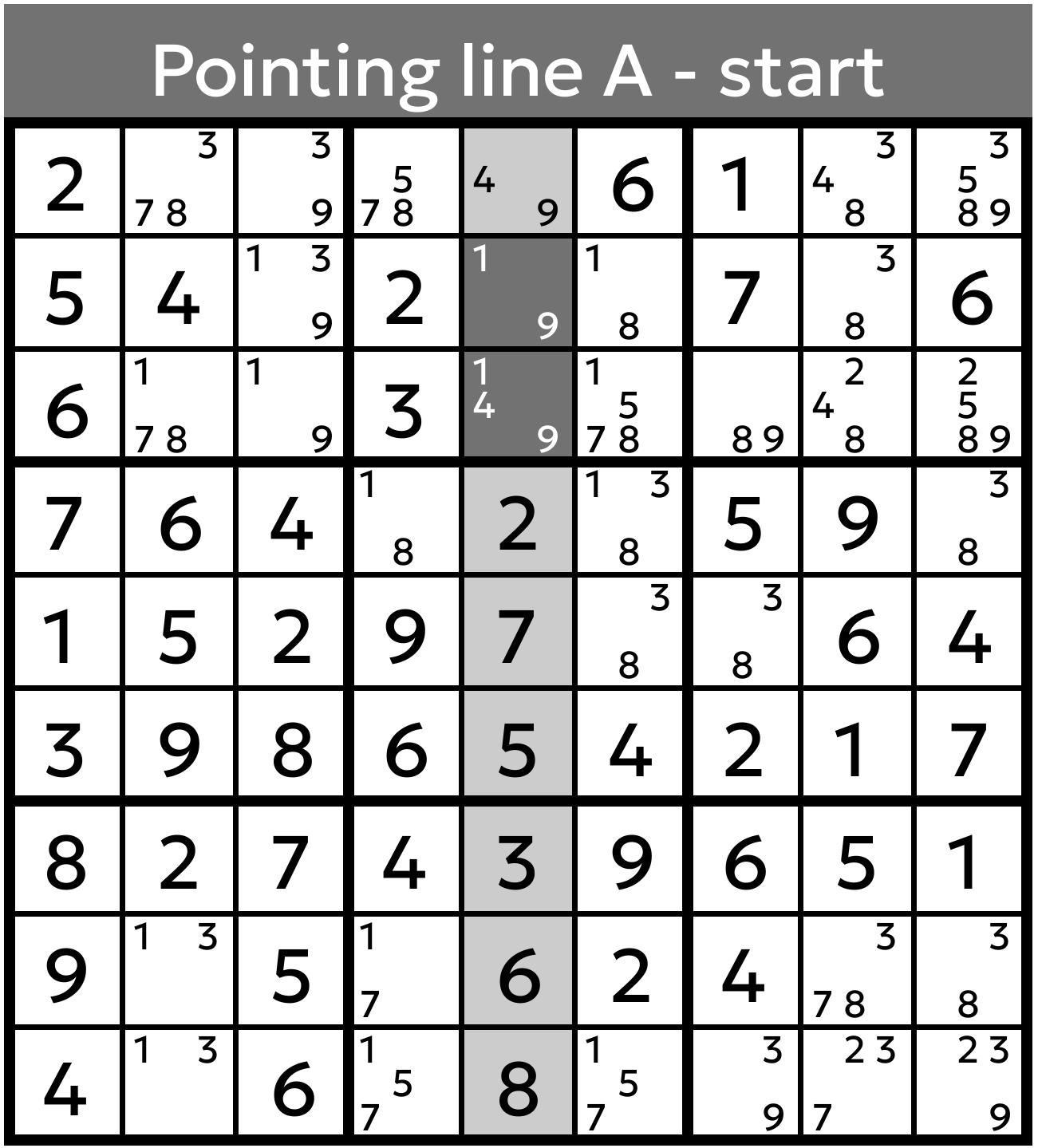
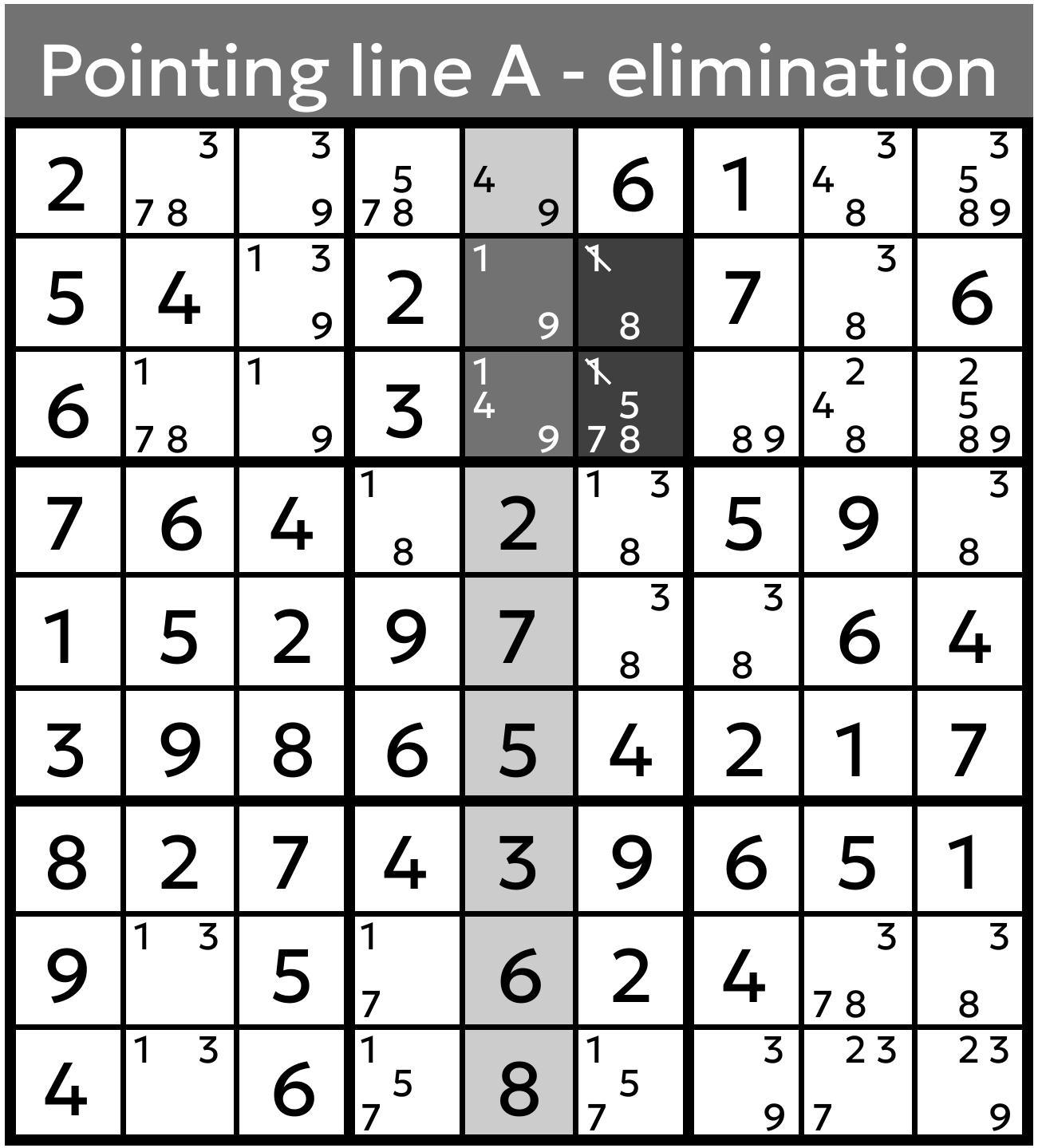
Examine column 5 and the value 1. Upon closer inspection, you'll observe that when considering this column, the number 1 should be placed in the upper box of the same column, specifically in the medium-gray shaded cells. While the exact cell for the value 1 in column 5 is not determined yet, it is guaranteed to be in one of the medium-gray shaded cells. Since it is certain that 1 is in one of these cells, the other cells in the same box cannot contain the number 1.
Consequently, you can eliminate 1 from columns 4 and 6 in the same box. During this elimination round, you could exclude 1 from the dark-gray shaded cells. This leads to an immediate solution: By eliminating 1 from the cell in row 2, column 6, only 8 remains as the single candidate.
B variant
You attempt to find a value for which all possible positions within a box are in the same line (either a row or column). In this case, you can eliminate the value from the other boxes along the same line.
Take a look at the example below.
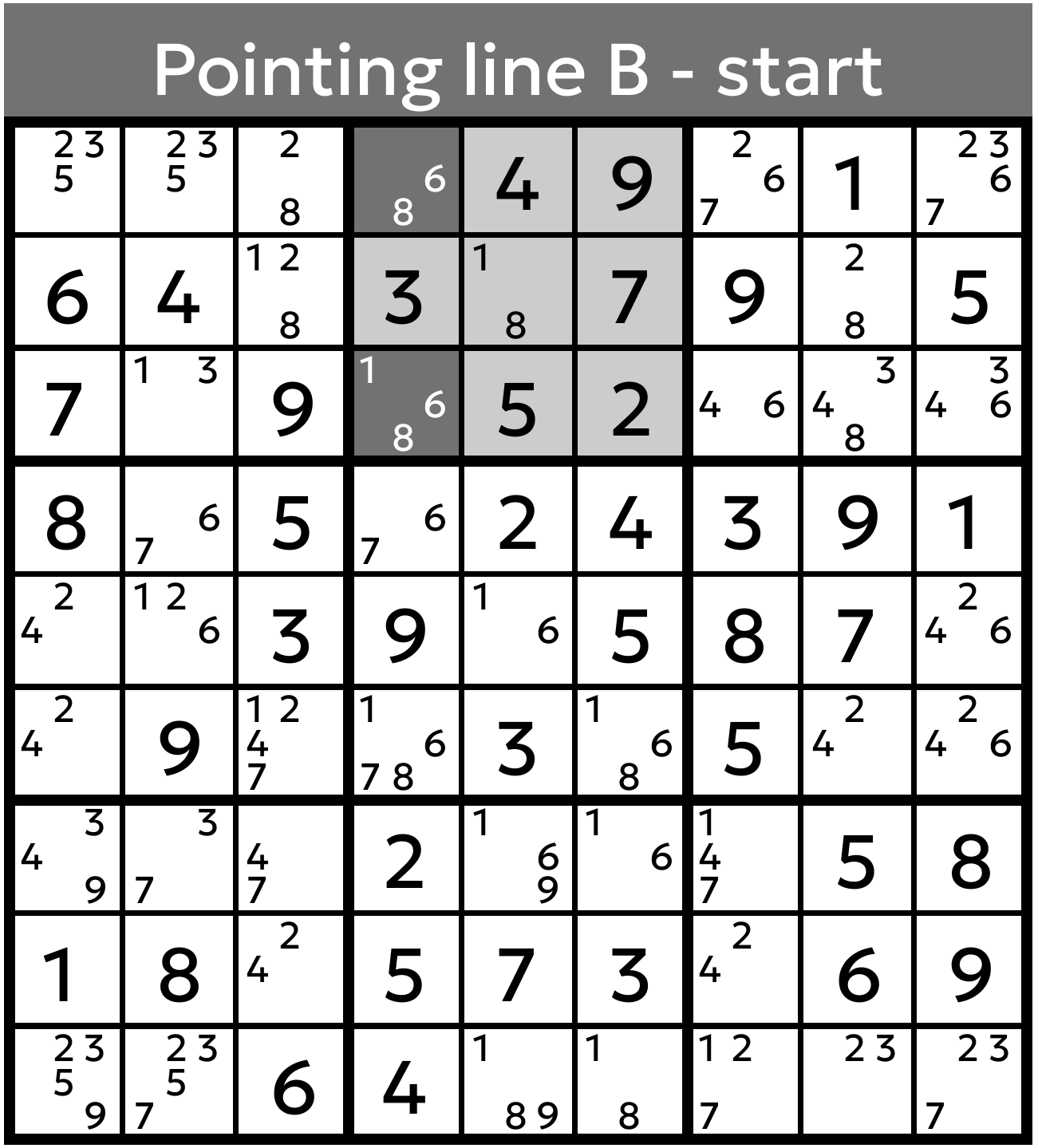
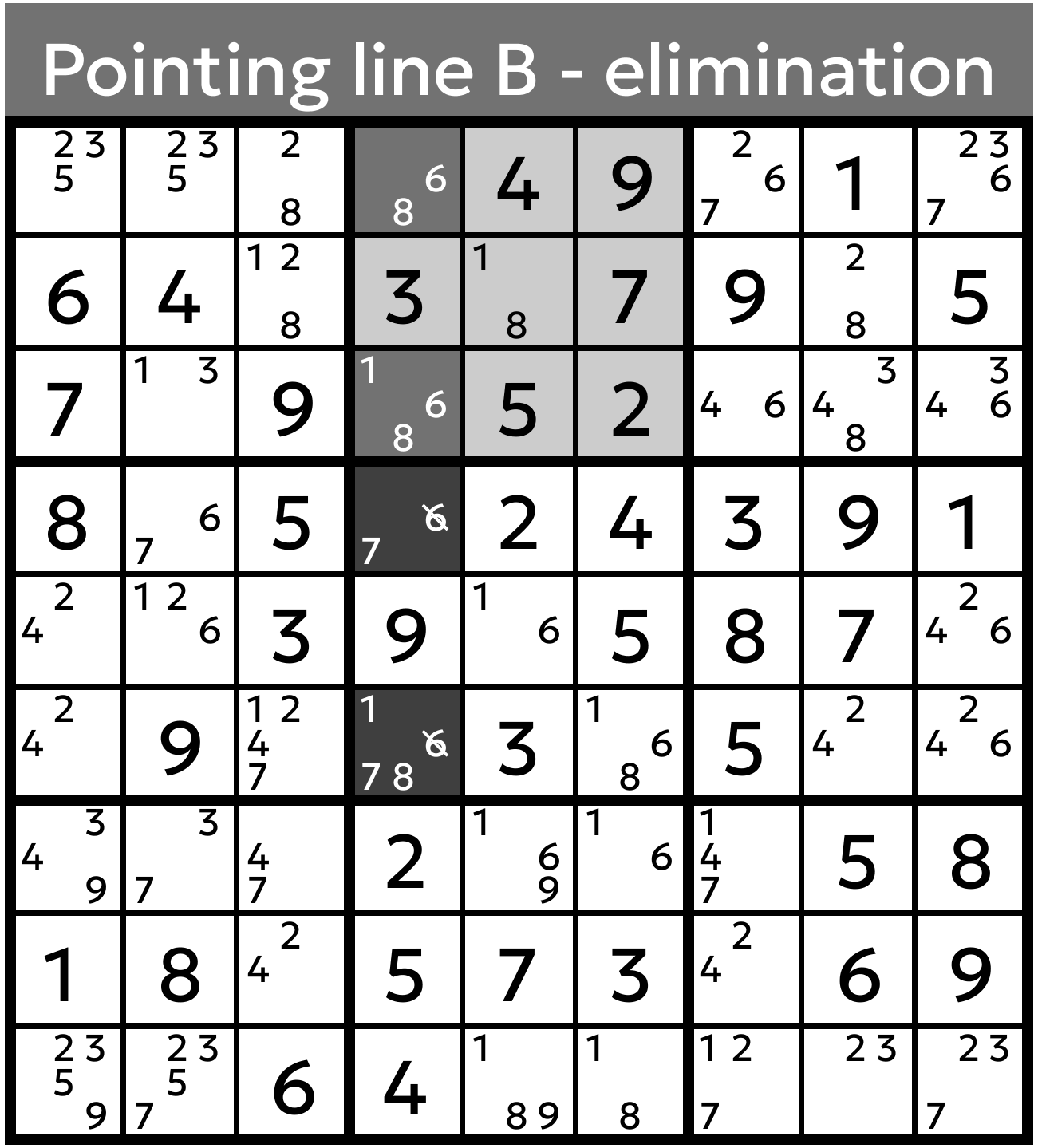
Notice that in the top-middle box, the number 6 is present in a single column. This implies that within column 4, the number 6 is in one of the medium-gray shaded cells, specifically in row 1 or row 3, and cannot be elsewhere. Consequently, you can eliminate 6 from cells in the other boxes along the same column. During this elimination round, you could eliminate it from the dark-gray shaded cells. This results in an immediate solution: By removing 6 from the cell at row 4, column 4, only number 7 remains as the single candidate there.
2/page · Medium #1 in the free sample, move 13. Open the app at this move and step through it.